By:
Brandon Shafer
Italian Architecture

Renaissance and Mannerist

Possibly the most popular architectural period of them all, the Renaissance took place from about 1400 to 1600 AD. Over this span of 200 years, many new styles and innovations poped up around Italy and all of Europe. Since this cultural movement began in Italy, and spread to the rest of Europe, Italy can be seen as the pioneers of the Renaissance. This was especially popular in Florence, where great architects built structures such as the Florence cathedral. The architects involved were also interested in achieving a golden age, using knowledge in their buildings and classical examples. Because this time period was a sort of classical revival, many of the styles used in Greek and Roman times make a reappearence with added features to create a unique and scholarly architectual time period.
History:
Background

Details:
Styles
The goal was to study and master the style of the Romans, and architects did so through their use of detail. Mouldings stood out against the doors, unlike in Gothic architecture, and stautes and sculptures were placed around the building unlike Medieval architecture.
Columns:
These Roman-style columns were used in many Renaissance buildings as decoration and structural support. The different Roman pillars were used: Tuscan, Doric, Ionic, Corinthian and Composite, showing the classical revival of the Renaissance.
The Dome:
Being used in large buildings to be visible from the exterior, and in smaller buildings to be visible from the interior, the dome gained massive significance in the Italian Renaissance. At first it was used for churches and religious buildings, but later used for more secular purposes.


This great representation of Renaissance architecture is in the epicenter of the Renaissance culture. The large dome, pillars, and immense detail that went into this structure highlights the Renaissance tim period.

This basilica, similar to the Florence Cathedral, shows great use of Roman columns, and a large dome, with decorations covering both the inside and out.
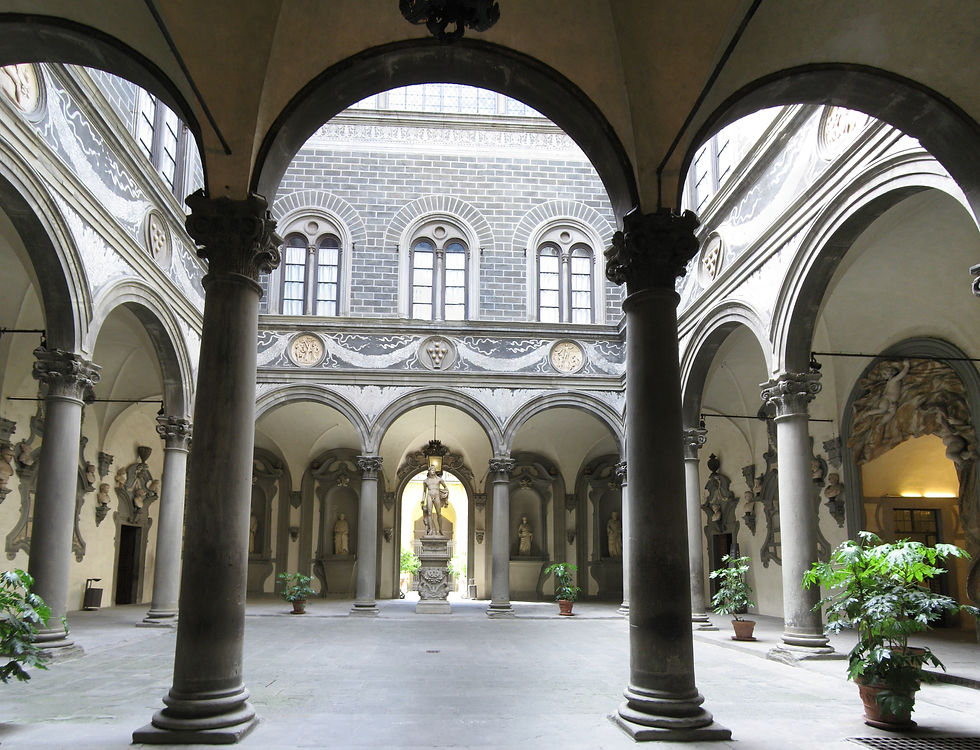
The inner courtyard of this palace hows the roman columns and the characteristic decoration that was involved during this architectural time period.

This most famous basilica owes its popularity to the incredible architecture. It's use of pillars and columns, along with a magnificent dome and incredible detail, embodies the meaning of Renaissance architecture.